How to Choose a NetSuite Implementation Partner: 6 Steps, Real Costs, and German Compliance
NetSuite implementation partners separate on the consultants they name, the scope governance they document, and the German compliance work they have already delivered.
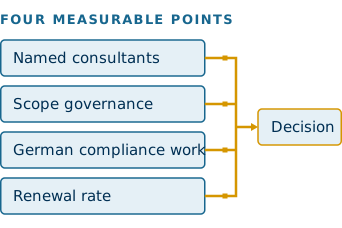
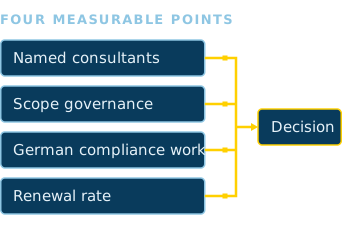
NetSuite implementation partners separate on four measurable points: the consultants they name, the scope governance they document, the German compliance work they have already delivered, and the managed services renewal rate they can quote. Everything else in a pitch deck is decoration.
The platform rarely fails. Delivery does. Rescue projects cost two to three times the original budget, and swapping partners mid-project adds six months or more to the schedule. Buyers who choose a NetSuite implementation partner on price alone tend to pay for the work twice.
This guide walks through partner types, real cost ranges, the German compliance obligations that no generic buying guide covers, the vetting questions that expose weak delivery models, and the warning signs that justify walking away. Cloudmaven publishes it as a certified Oracle NetSuite Solution Provider and structures its own NetSuite implementation services around the same tests.
What Is a NetSuite Implementation Partner?
A NetSuite implementation partner is a firm authorised by Oracle to sell NetSuite licences, configure the platform, and build extensions on it. Oracle grants the certification. The firm carries the delivery risk.
Oracle NetSuite ships as a software-as-a-service platform, which means it arrives configured for nobody in particular. Chart of accounts, approval routing, subsidiary structure, tax codes: all of it starts empty. The partner turns a generic cloud ERP tenant into a system that matches your close process.
Two roles sit inside that single word. The commercial role covers licensing, subscription terms, and renewal. The delivery role covers design, build, migration, and support.
Certification alone proves very little. Almost every firm on the market can produce the same badge set, because the entry requirements are documented publicly and the training is standardised.
One structural fact shapes every partner relationship: NetSuite runs on a bi-annual release cycle, and Oracle upgrades every account automatically. Your partner either builds for that cycle or builds against it.
Partner status tells you who is allowed to do the work. The selection process tells you who should.
How Do You Choose a NetSuite Implementation Partner Step by Step?
Buyers choose a NetSuite implementation partner through a six-stage process that runs eight to twelve weeks and ends with reference calls, not with a discount negotiation. Compressing it below six weeks removes the evidence you need.
1. Shortlist
Duration: 1 week
Output you should hold at the end: 3 to 5 named firms with industry evidence
2. Introductory calls
Duration: 2 weeks
Output you should hold at the end: Each firm's delivery model and staffing answer
3. Paid discovery
Duration: 2 to 4 weeks
Output you should hold at the end: Requirements document from 2 to 3 finalists
4. Proposal review
Duration: 1 week
Output you should hold at the end: Itemised scope, assumptions, change order policy
5. Reference calls
Duration: 1 week
Output you should hold at the end: 2 to 3 verified customers per finalist
6. Decision
Duration: Days
Output you should hold at the end: Signed statement of work with named resources
Build a shortlist of three to five
Shortlists work best at three to five firms, sourced from Oracle's partner directory, industry peers, and documented case studies in your vertical.
Five firms produce enough contrast to judge. Ten produce noise. Filter on four signals before the first call:
- NetSuite as a primary business line, not a side offering
- Delivered projects in your industry and your entity structure
- Consultants located in a timezone that overlaps your finance team
- Willingness to run a structured ERP evaluation before quoting
Run paid discovery with finalists
Paid discovery buys you a requirements document from two or three finalists, which turns a sales conversation into a comparable deliverable.
Discovery costs money. That is the point. A firm that maps your order to cash flow for a fee will not invent assumptions later to protect a fixed price.
Compare itemised proposals
Itemised proposals expose scope gaps that headline prices hide, so demand line level hours per phase and per module.
Read three things first: the assumptions section, the exclusions section, and the change order clause. Those three paragraphs decide your final invoice.
Call every reference
Reference calls surface delivery behaviour that proposals never mention, and two to three calls per finalist is the working minimum.
Ask each reference four questions:
- Which consultants actually configured your system, and did they change mid-project?
- What did the partner get wrong, and how did they handle it?
- How long did go-live support last, and what did it cost?
- What would you do differently next time?
Decide on fit, not price
Fit beats price because the cheapest quote usually carries the thinnest scope, and thin scope reappears as change orders.
Most buyers feel the pull toward the lower number. Resist it. The delta between the cheapest and the most credible proposal is normally smaller than the cost of one rescue phase.
That process tells you how to run the evaluation. The next question is what you are actually buying.
What Does a NetSuite Implementation Partner Actually Deliver?
A NetSuite implementation partner delivers three separable things: the licence subscription, the configured environment, and the documentation that lets somebody else maintain it. Weak partners deliver only the middle one.
The licence is Oracle's product. The configuration is the partner's work. The division matters because a Solution Provider Partner earns margin on the subscription and holds an annuity interest in your renewal, which aligns their incentives with your retention.
Deliverables worth naming inside the statement of work:
- Business process review documenting current and target workflows
- Solution design document with the configuration rationale per decision
- Technical design document for every scripted extension, approved before code
- Data migration plan with test load counts and reconciliation reports
- Integration specification per connected system
- Training material and a documented handover package
- Work for hire IP language confirming you own the source code on payment
Ownership is where proposals go quiet. Some firms retain the intellectual property of custom scripts and licence them back, which converts your customisation into a subscription you cannot exit.
Cloudmaven runs licence, build, and support inside one accountable contract as an end to end implementation service, which removes the finger pointing that appears when the reseller and the implementer are different companies. The platform itself, Oracle NetSuite, stays the constant across every partner you evaluate.
Scope defines the contract. Partner type defines who can execute it.
Which Type of NetSuite Partner Suits Your Business?
Six delivery routes exist for a NetSuite implementation, and the right one depends on entity count, customisation depth, and how much internal capacity you can commit for four months.
Solution Provider Partner
Sells the licence: Yes
Best fit: Mid-market, single accountable contract
Main risk: Quality varies widely between firms
NetSuite Alliance Partner
Sells the licence: No
Best fit: Global rollouts, large programme teams
Main risk: You become a small account
SuiteCloud Developer Network
Sells the licence: No
Best fit: Productised apps, deep code work
Main risk: No ownership of core delivery
Oracle direct services
Sells the licence: Yes
Best fit: Standard processes, template speed
Main risk: Limited flexibility outside the template
Accounting led providers
Sells the licence: Sometimes
Best fit: Finance heavy scopes
Main risk: Thin on inventory and manufacturing
In-house implementation
Sells the licence: No
Best fit: Strong internal ERP expertise
Main risk: Learning curve lands on your close
Solution providers
Solution Provider Partners resell NetSuite licences and implement them, which makes them the default choice for most mid-market buyers.
One contract covers software and services. One firm owns the outcome. Cloudmaven operates in this category as a certified Oracle NetSuite Solution Provider, and it also advises across a multi platform ERP portfolio, which keeps the platform recommendation separate from the licence commission.
Alliance partners
NetSuite Alliance Partners deliver implementation services without reselling licences, and they concentrate on large scale and international rollouts.
Rates run higher. Teams run larger. A company with 50 employees rarely receives senior attention inside that model.
SuiteCloud developers (SDN)
SuiteCloud Developer Network members build SuiteApps and complex extensions rather than running core ERP deployments.
Engage one when your requirement genuinely does not exist in the product. A licensed industry bundle beats a bespoke build on maintenance cost every time.
Oracle's own services team
Oracle's professional services organisation implements NetSuite using SuiteSuccess, the pre-configured deployment framework built on industry templates.
Speed is the benefit. Rigidity is the cost. Companies with non-standard revenue models or unusual subsidiary structures outgrow the template during discovery.
Accounting led providers
Accounting firms and BPO providers implement the financial modules well and the operational modules unevenly.
Their depth sits in the general ledger. Warehouse, procurement, and manufacturing scopes expose the gap quickly.
In-house implementation
Self-implementation works only when your team already holds NetSuite administration experience and can release two people full time.
Nobody learns SuiteFlow during a year-end close. Firms that attempt it usually convert to a partner mid-project, at which point strategic consulting becomes a rescue exercise rather than a design exercise.
Route selection sets the price band. The next section sets the number.
How Much Does a NetSuite Implementation Partner Cost in Germany?
NetSuite implementation partners price against the first year licence fee, and published market ranges run from $25,000 for a single entity build to $200,000 and above for multi-subsidiary manufacturing scopes.
Two formulas circulate in the market, and they disagree. One prices implementation at one to three times the annual subscription. The other prices small business projects at one to two times the first year licence and mid-market projects at 0.67 to 1.0 times. Both describe the same reality: bigger licences carry proportionally lower implementation multiples.
Single entity, core financials
Typical range: $25,000 to $50,000
Cost drivers: Chart of accounts, basic workflows
Mid-market with integrations
Typical range: $50,000 to $100,000
Cost drivers: Connectors, data volume, reporting
Multi-subsidiary or manufacturing
Typical range: $100,000 to $200,000+
Cost drivers: OneWorld, consolidation, inventory depth
Enterprise programmes
Typical range: $100,000 to $500,000+
Cost drivers: Global rollout, regulatory validation
The real number is the proposal plus the change orders. Change orders arrive when scope assumptions break, and assumptions break on almost every project, because no partner scopes an environment perfectly from three discovery calls.
Scope creep is a governance failure, not an accident. Ask which threshold triggers a formal change order, who approves it, and what stays inside the original price.
A quote well below the market band is the expensive option. Missing scope does not disappear. It reappears at premium hourly rates, six weeks after kickoff, with your project too far advanced to pause.
Time to value answers the cost objection better than payback tables. Finance teams measure it in close days removed, manual reconciliations eliminated, and reporting cycles shortened, which is the same lens Cloudmaven applies through measurable efficiency gains work.
Budget sets the band. German statutory obligations decide whether the build is usable at all.
Does Your Partner Need German and DACH Implementation Experience?
German implementations carry statutory obligations that a generic NetSuite build does not satisfy: GoBD-compliant archiving, DATEV-compatible exports, structured e-invoicing, and works council consultation before go-live.
This is the section every international buying guide skips. Cost and timeline questions repeat across every market. Compliance does not.
GoBD-compliant record keeping
GoBD requires immutable transaction records, a complete audit trail, and ten-year retention with tax auditor access to the underlying data.
The practical deliverables:
- Verfahrensdokumentation describing how records enter, move through, and leave the system
- Locked accounting periods with logged, attributable changes
- Retained document links between transaction and source file
- Export formats a Betriebsprüfer accepts without manual reformatting
Annual reporting sits on the same foundation, and the Jahresabschluss under HGB inherits whatever discipline the implementation established.
DATEV and tax adviser handoff
DATEV compatibility decides whether your Steuerberater accepts the data or rekeys it, and rekeying destroys the close time savings you bought NetSuite for.
Two chart of accounts standards dominate German practice: SKR03 and SKR04. Your partner maps NetSuite's account structure to one of them, then automates the transfer through a NetSuite to DATEV integration rather than a monthly CSV ritual. VAT filings run separately through ELSTER, and the return data must reconcile to the ledger without adjustment.
E-invoicing readiness
Germany's E-Rechnung mandate has required domestic businesses to receive structured electronic invoices since January 2025, with issuing obligations phasing in during 2027 and 2028.
Two formats matter. XRechnung is pure XML. ZUGFeRD embeds XML inside a PDF. Ask your partner which formats the environment handles today, on both inbound and outbound flows, and how approval routing behaves once the invoice arrives as data rather than as a scan. Companies that already run a digitised invoice approval workflow reach the deadline with configuration work rather than a project.
Multi-entity and multi-currency setups
Multi-entity structures require NetSuite OneWorld, which handles subsidiary hierarchies, intercompany eliminations, and multi-currency consolidation natively.
German groups with Austrian or Swiss entities need three things configured together: local statutory chart requirements, group reporting under IFRS 15 or ASC 606 for revenue, and consolidated close in a single ledger. DSGVO obligations and EU data residency belong in the same conversation, so confirm which data centre region hosts the account before signing the order form.
German language support and hours
Support hours must overlap your close calendar, and German language capability matters most during user acceptance testing and training.
One German requirement never appears in partner proposals: the Betriebsrat. Works councils hold co-determination rights over systems capable of monitoring employee performance, which covers time tracking, project logging, and approval analytics. Start that consultation during discovery, not during go-live week. Cloudmaven's Swiss localisation work follows the same principle across the DACH region, where local statutory detail decides adoption.
Compliance defines the build. Sequence defines how long the build takes.
How Long Does Implementation Take From Kickoff to Go-Live?
NetSuite implementations run eight to sixteen weeks for a straightforward mid-market scope and three to nine months once multiple entities, heavy customisation, or complex integrations enter the picture.
Those two ranges look contradictory. They are not. Entity count, integration count, and data quality explain the entire gap, and Cloudmaven maps them in the first week through our implementation process.
Discovery
Typical duration: 1 to 2 weeks
Most common failure: Skipped or compressed to two calls
Configuration
Typical duration: 2 to 4 weeks
Most common failure: Workarounds instead of clean design
Data migration
Typical duration: 2 to 4 weeks
Most common failure: One test load instead of three
Integrations
Typical duration: 2 to 4 weeks
Most common failure: Complexity discovered late
Testing and training
Typical duration: 2 to 4 weeks
Most common failure: UAT treated as a formality
Go-live and hypercare
Typical duration: 2 to 4 weeks
Most common failure: Partner disappears after week one
Discovery and process mapping
Discovery documents how your business actually operates, which differs from both the org chart and the process manual.
A business process review challenges the workflow before anyone configures it. Automating a broken approval chain simply produces broken approvals at higher speed.
Configuration and workflows
Configuration converts requirements into system behaviour using native settings, SuiteFlow workflows, saved searches, and SuiteAnalytics reporting.
Delivery method changes the rhythm here. Agile versus waterfall is a real choice: SuiteSuccess templates suit standard processes, while two week sprints suit builds with custom logic and evolving requirements.
Data migration and cleansing
Data migration consumes more hours than any other phase, and dirty source data produces a dirty production tenant.
Three test loads is the working standard. Ask for reconciliation reports after each one, covering open balances, open orders, and item master counts.
Integrations with existing systems
Integrations connect NetSuite to the systems your team refuses to abandon, and each connector carries its own scope.
Prebuilt connectors move fast. Custom flows do not. Cloudmaven delivers this layer through integrations and middleware architecture, including a HubSpot connector for pipeline to invoice handoff, a Personio connector for HR to payroll data, and the eUnify middleware platform for everything without a standard bundle.
Testing and user training
User acceptance testing validates real transactions against real scenarios, and it belongs to your team rather than the partner's.
Adoption fails more often than technology does. Structured user training, combined with a change management plan and early end user involvement, is what converts a configured system into a used system.
Go-live and hypercare
Go-live starts the hardest phase, because production usage surfaces the issues that testing never triggered.
Phased versus big bang go-live is a risk decision, not a preference. Thirty to ninety days of hypercare is the market standard, and customer success and IT support should be contracted before the switch flips, not after.
Timelines describe the plan. Questions expose whether the partner can hold it.
Which Questions Reveal How the Partner Really Works?
Six questions expose the structural realities that credentials, methodology slides, and price sheets hide. Ask them in the first meeting, not the third.
Partners are not incentivised to invite these questions. That is precisely why they work.
Named consultants and tenure
Named consultants prove accountability, because the senior team selling the project rarely configures it.
Ask exactly this:
- Which consultants will work on my engagement, with names, tenure, and projects led?
- What share of configuration will the people in this room perform?
- What is your protocol when a consultant leaves mid-project, and how long is the handover?
Scope-change governance
Scope change governance separates commercial honesty from a back billing model.
Request a specific example from a recent engagement where the assumptions broke. Vague answers here predict invoices later. Ask who absorbs the cost when the customisation layer proves deeper than the proposal assumed.
Custom code versus configuration
Configuration survives upgrades. Custom code accumulates technical debt, and every script written unnecessarily is a maintenance liability you fund forever.
Strong partners articulate a threshold for scripting versus configuring, build with SuiteScript 2.x against current APIs, and run release preview testing before each upgrade reaches general availability. A native module such as standard revenue recognition usually beats a bespoke script for the same requirement.
Documentation and handover
Documentation determines whether your environment stays maintainable after the original consultant moves on.
Ask to see a real example from a recent project. Configuration rationale, workflow logic, and integration mappings belong in plain language, held somewhere you can access without a support ticket.
Managed-services renewal rate
Renewal rate is the single most revealing number a partner can produce, because it measures whether customers stay after the implementation margin is booked.
Ask for the figure. A partner tracking it answers immediately. Continuity matters as much as the number, so confirm whether managed services uses the consultants who built your environment or a separate support pool.
Industry-specific configuration
Industry depth changes configuration decisions, not just the case study slide.
Ask which choices differ for your vertical, how many clients in that vertical they have delivered, and the three configuration mistakes they see repeatedly. Cloudmaven publishes its vertical work for software and SaaS companies, professional services firms, wholesale and distribution, renewable energy, and advertising and marketing agencies.
Good answers earn a shortlist place. Certain answers end the conversation.
What Warning Signs Mean You Should Walk Away?
Four warning signs predict failure reliably enough to justify ending an evaluation: pricing before discovery, compressed timelines, unpriced change mechanics, and no plan for the first ninety days after go-live.
Pricing before discovery
Pricing before discovery means the partner is quoting a template rather than your business.
The number arrives fast because nobody investigated the requirements. Partners who demonstrate features without asking about your order to cash flow deliver a system built for a generic company. Reading what an ERP system actually does before the first demo puts the process conversation ahead of the feature tour.
Timelines under eight weeks
Timelines under eight weeks signal cut corners, usually in testing, training, and data migration.
Something has to give. The mess arrives later and costs more to unwind than the original build.
Unpriced change orders
Unpriced change mechanics turn an attractive quote into an open-ended commitment.
Watch for three phrases in a proposal: no itemised scope, no change order policy, and integrations to be defined later. Each one shifts risk onto you.
No plan for the first 90 days
A missing post-launch plan leaves you alone during the exact window when real issues surface.
Ask what support covers, for how long, and at what cost. Ask for references too, and a partner unable to connect you with recent customers has answered the question already. Verifiable customer success stories are the counterweight to a polished pitch.
Which NetSuite Partner Services Does Cloudmaven Provide in DACH?
Cloudmaven delivers NetSuite licensing, implementation, integration, and ongoing support as a certified Oracle NetSuite Solution Provider, operating from Olten in Switzerland across the DACH region and wider EMEA.
Cloudmaven AG positions itself as a CFO advisor rather than a software reseller, and the numbers behind that claim are specific: 16+ locations, 30+ countries, 120+ ERP and EPM employees, 350+ customers, and 600+ projects. Clients include Breitling, Bitpanda, Stadler, and Austrian Airlines. The full company profile sits on the about Cloudmaven page.
The strategy is "be global, act local". International delivery capacity, local statutory knowledge.
Implementation and process design
Implementation follows a documented phase model with named consultants assigned before kickoff, which answers the first vetting question in this article directly.
Discovery precedes pricing. Design decisions carry written rationale. Handover material transfers to your team rather than staying inside a consultant's inbox.
Module and industry expertise
Module coverage spans the operational and financial scope that mid-market groups actually run, configured per industry rather than per template.
- Financial management
- Inventory management
- Warehouse management (WMS)
- Procurement management
- SuiteProjects
- SuiteBilling
- CRM
- Human capital management
Qualifyze reports the outcome in hours saved: revenue recognition previously consumed five working days of one employee and now runs fully automated in NetSuite.
Integrations and middleware architecture
Integration work connects NetSuite to the surrounding system landscape through prebuilt connectors and the eUnify middleware layer.
Travel and expense management runs through Perk, with expense data flowing into the ERP automatically rather than through monthly imports. AI supported process automation handles the repetitive document and matching work that consumes finance headcount.
Managed services and ongoing support
Managed services continue after hypercare ends, covering release testing, configuration changes, and new entity rollouts.
Support follows agreed service levels. For EPM engagements, 24/7 customer support can be booked as an additional service. The relationship model matters more than the launch date, because year three of an ERP system looks nothing like month three.
EPM and CFO advisory
Enterprise performance management extends NetSuite into planning, budgeting, forecasting, consolidation, and ESG reporting, with Abacum available for teams that need lighter planning tooling.
CFO advisory connects the system to the decisions it supports. The measurable output is a faster month end close, which is the metric most German finance teams use to judge whether the ERP project succeeded.
Evidence beats credentials. The final decision belongs to you.
Frequently Asked Questions
What is a NetSuite implementation?
A NetSuite implementation is the project that turns an empty NetSuite tenant into a working system, covering discovery, configuration, data migration, integration, testing, training, and go-live support. The work typically runs eight weeks to nine months depending on entity count and customisation depth.
What is the difference between a solution provider and an alliance partner?
Solution Provider Partners sell NetSuite licences and implement them under one contract. NetSuite Alliance Partners provide implementation services only, with the licence purchased separately from Oracle. Solution providers suit mid-market buyers who want single point accountability. Alliance partners suit large multinational programmes needing scale.
How many NetSuite implementations should a partner have completed?
Fifty completed implementations is a reasonable floor for a mid-market build, with a meaningful share inside your industry. Volume alone proves little. Ask how many the specific consultants assigned to your project have delivered, since firm totals and individual experience often diverge sharply.
What is the failure rate of NetSuite implementations?
Oracle publishes no NetSuite specific failure rate, and any precise percentage circulating online lacks a verifiable source. Measurable indicators exist instead: rescue projects cost two to three times the original budget, and switching partners mid-project adds six months or more to delivery.
What is the NetSuite controversy?
Criticism of NetSuite concentrates on three recurring complaints from customers: subscription price increases at renewal, automatic renewal clauses that require early notice to exit, and wide quality variance between implementation partners. Negotiate renewal caps and notice periods in the initial contract rather than at renewal.
Who is NetSuite's biggest competitor?
SAP S/4HANA Cloud is NetSuite's largest competitor in the German mid-market, followed by Dynamics 365 Business Central and Dynamics 365 Finance & Operations. Lighter alternatives include iplicit and Lensing, and a structured view sits in this comparison of AI-native ERP systems.
Can you switch NetSuite partners in the middle of a project?
Switching partners mid-project is possible and adds roughly six months to the timeline, because the incoming firm must rediscover the configuration decisions already made. Documentation quality determines the cost. Request the full handover package, including scripts, workflow logic, and migration mappings, before terminating the original agreement.
Can you implement NetSuite without a partner?
Self-implementation works only for organisations holding existing NetSuite administration expertise and able to release two people full time for the duration. Most companies without that capacity engage a partner after an initial attempt, which raises total cost because remediation follows discovery rather than preceding it.
Does NetSuite support German statutory reporting and GoBD requirements?
NetSuite supports German statutory reporting once the partner configures it correctly, covering GoBD-compliant archiving, SKR03 or SKR04 account mapping, DATEV exports, HGB reporting structures, and XRechnung or ZUGFeRD invoice formats. Confirm each item in the scope document, since none of it exists in a default account.
The Decision That Shapes the Next Five Years
Partner choice outlives the project by years, which is why buyers who choose a NetSuite implementation partner carefully spend less than those who choose quickly. The software stays constant across every proposal you receive. Delivery quality does not.
The right partner leaves you with clean data, documented customisations, a team that uses the system, and a close that runs faster every quarter. The wrong one leaves workarounds, undocumented scripts, and an environment nobody wants to touch.
Re-implementation costs more than the original build. Choose once.
Bring your requirements, entity structure, module scope, and timeline to a scoping conversation, and request a scoped proposal with a written assumption list attached.