NetSuite Implementation Problems: Causes, Warning Signs and Fixes
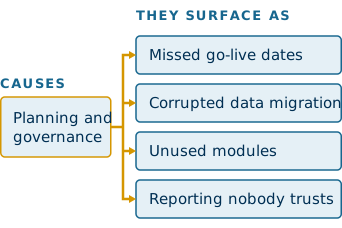
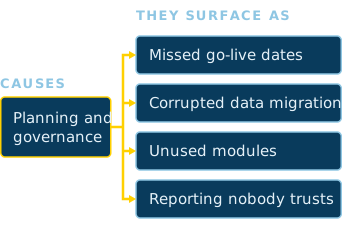
NetSuite implementation problems are project failures, not software failures. They surface as missed go-live dates, corrupted data migration, unused modules and reporting nobody trusts. This guide maps every cause, the warning signs that appear before go-live, the German compliance traps competitors ignore, and the recovery sequence that stabilises a failing rollout. Gartner data, cost figures and a phase-by-phase diagnostic follow.
What is NetSuite implementation?
NetSuite implementation is the structured project that configures Oracle NetSuite around a company's financial and operational processes, migrates its legacy data, tests the result and moves users onto the live system.
The project covers five workstreams that run in sequence and overlap at the edges:
Discovery: entity structure, chart of accounts, close cycle and integration landscape are documented
Design: approval workflows, consolidation logic and revenue recognition rules are agreed before build
Build: sprint based configuration, data migration and integration development
Go-live: cutover, parallel run and a signed off first financial close
Scale: module expansion, optimisation and ongoing support
Oracle NetSuite ships with a preconfigured delivery framework called SuiteSuccess, which packages industry leading practices into a faster rollout. Cloudmaven, a certified Oracle NetSuite Solution Provider, layers its own five phase methodology on top of that framework so financial architecture gets designed before any module is switched on.
Most buyers underestimate one thing. The software arrives complete; the operating model does not.
A typical NetSuite project runs 3 to 8 months. That timeline is where the trouble usually starts.
What counts as a NetSuite implementation problem?
A NetSuite implementation problem is any outcome where the deployed system fails to deliver the business result it was bought for, even when every configuration task was technically completed on schedule.
The symptoms cluster into five recognisable patterns:
- Go-live or MVP milestones slip repeatedly with no single owner accountable
- Data migration lands inaccurate, incomplete or duplicated records in the general ledger
- Modules sit unused because onboarding covered screens instead of processes
- Shadow processes appear as teams rebuild their old workflow in spreadsheets
- Reporting errors erode executive confidence in the numbers
ERP implementation failure rarely announces itself. It accumulates through one-off workarounds, inconsistent reports and quiet team scepticism until the system becomes functional but untrusted. That phrase describes the real end state of most troubled projects better than the word "failure" does.
Completing an implementation is not the same as succeeding at one. A system that went live on time, on budget, and changed nothing about decision quality has already failed.
The distinction matters commercially. Oracle NetSuite as a platform is rarely the broken component, which is why replacing the software almost never fixes the problem. Understanding how an ERP system actually works separates platform limitations from project execution gaps.
Knowing what failure looks like raises the obvious follow-up question: how common is it?
How often do ERP implementations actually fail?
ERP implementations fail at rates between 43% and 70% depending on how each source defines failure, which is why published statistics on NetSuite implementation problems appear to contradict each other.


Four credible figures circulate in this market:
| Source | Figure | Definition of failure used |
|---|---|---|
| Gartner | Over 70% fall short of original business use case goals, up to 25% fail catastrophically | Business outcome, not delivery |
| Oracle NetSuite | Up to 50% of ERP implementations fail on the first attempt | Requires rework or restart |
| Industry benchmark | 67% exceed budget due to scope creep from unclear financial requirements | Budget variance only |
| Industry benchmark | 43% re-implement within three years from poor initial configuration | Long term configuration quality |
The numbers disagree because each measures a different thing. Gartner measures value delivered. Budget studies measure variance against an estimate that was often wrong from the start. Re-implementation rates measure design durability, which is the metric that actually predicts total cost of ownership.
Panorama Consulting's 2025 ERP Report adds the variable everyone underestimates: average project timelines dropped from 15.5 months to 9 months, largely because of cloud platforms. Faster delivery removes the slack that used to absorb mistakes.
Less time means smaller errors do more damage.
Cloudmaven publishes its own counter-benchmarks against those figures, including 98% on-time delivery across 600+ projects, documented alongside its ERP implementation risk benchmarks.
Statistics describe the scale of the risk. The causes explain why it keeps repeating.
Why do NetSuite projects go wrong so consistently?
NetSuite implementation problems trace back to eight repeatable root causes, and seven of the eight originate in planning and governance rather than in the software itself. Each cause below carries its countermeasure.
Vague or undocumented requirements
Vague requirements produce vague configuration, because the build team fills undefined gaps with assumptions instead of decisions.
"Improve reporting" and "automate finance" are not requirements. A usable requirement connects a business need to a specific process, role, control, report or system behaviour, and defines how success gets tested.
Undocumented processes create a second failure downstream: the ERP ends up reflecting what leadership believes the system does, not how the work is actually performed. Fixes then arrive after go-live at the highest possible cost.
A structured ERP evaluation forces those definitions into writing before the licence is signed.
No owner for key decisions
Decision ownership collapses when a steering committee replaces named process owners, and configuration then proceeds on unverified assumptions.
Assign a single accountable owner for each of these areas:
- Financial structure and chart of accounts
- Order management and fulfilment
- Purchasing and inventory
- Revenue recognition
- Reporting and dashboards
- Security and user roles
- Integrations and data quality
Each owner needs authority to approve requirements and resolve disagreements within days, not sprint cycles. Cloudmaven builds this ownership map during Discovery and pairs it with strategic consulting for finance leadership so the CFO carries the mandate rather than the IT department.
Scope that expands without review
Scope creep enters through small requests that each look reasonable in isolation and collectively make the launch unpredictable.
An approval rule gets added. A report appears because an executive asked. A legacy customisation is kept "just in case".
Change control fixes this with four mandatory fields per request: owner, business rationale, impact assessment, decision. Approved changes enter the roadmap; deferred changes enter a visible post-launch backlog nobody can quietly reopen. Disciplined management consulting keeps that boundary enforced when internal politics push against it.
Customisation before configuration
Over-customisation creates brittle environments that break during automatic upgrades and confuse the users they were meant to help.
Before approving any custom script or workflow, document four things: the native option, the business gap, the control that requires a different approach, and who owns the custom feature in three years.
Rebuilding every legacy habit inside NetSuite forfeits the improvement the project was funded to deliver. Reviewing the standard modules available out of the box usually removes 30% to 50% of a requested customisation list.
Dirty data carried into migration
Data migration fails when teams treat it as a technical upload instead of a business decision about which records deserve to survive.
Legacy sources rarely agree with each other. QuickBooks, Microsoft Dynamics GP, department spreadsheets and paper files each hold a version of the same customer, and none of them is authoritative.
Run this sequence:
- Inventory every source system holding financial or master data
- Cleanse duplicates, standardise formats and correct inaccuracies
- Execute a trial load and reconciliation against trusted financial reports
- Obtain formal sign-off from the business owner of each data domain
- Reconcile open orders, purchase orders, invoices, credits and inventory separately
Migration commonly consumes 10% to 15% of total project cost. Clean master data feeds directly into the NetSuite financial management module, where errors become audit findings rather than inconveniences.
Integrations built for the happy path
Integration design fails when it proves that a normal sales order transmits successfully and stops there.
Real operations generate returns, partial shipments, duplicate messages, missing addresses, invalid tax data, cancellations and delayed responses. Every one of those needs defined behaviour.
Source-of-truth ownership is the control most projects skip. When a CRM, an ecommerce platform and NetSuite all update the same field with no hierarchy, values conflict and users stop trusting records. Cloudmaven's eUnify middleware layer handles error visibility, retry behaviour, alerting, logging and escalation as native functions rather than afterthoughts, connecting SAP, HubSpot, Personio and banking systems through one governed architecture.
Testing that starts too late
Testing that begins after configuration freezes exposes flawed requirements at the point where changes cost the most.
User acceptance testing differs from a demonstration in one respect: a demo follows an ideal sequence with complete data, while UAT runs real scenarios under time pressure with incomplete information. Finance cannot be the only participant. Sales, purchasing, operations, inventory and administrators each validate their own workflows.
Defect triage needs structure per issue: description, severity, owner, target resolution, retest status, final disposition. Testing without exit criteria produces confidence, not evidence.
Adoption left until after go-live
Adoption planning starts during design, because users who first see the system in training week have no stake in its success.
Role based training beats feature training every time. A buyer needs different instructions from an accounts payable specialist, and an approver needs different guidance from an employee entering transactions.
The NetSuite Sandbox lets teams rehearse against realistic data without risk of damaging production. Training material that disappears after launch guarantees shadow processes; quick reference guides, recorded sessions and documented procedures prevent them.
Root causes explain the mechanism. Timing explains when you can still intervene cheaply.
When do the first warning signs appear?
Warning signs of NetSuite implementation problems appear during planning, months before go-live, and each phase produces its own distinct signal set. Reading them by phase converts a static risk list into a live diagnostic.


Signals during planning and design
Planning phase signals centre on missing artefacts rather than visible errors, which makes them easy to dismiss as administrative gaps.
Watch for these five:
- The roadmap shows broad milestones like "configuration" and "migration" with no dependencies, owners or decision points
- Nobody can name the next three decisions blocking progress
- Requirements exist as goals rather than as documented process behaviour
- Scope additions arrive without impact assessment
- Data ownership across systems remains unresolved
Configuration cannot finalise while the chart of accounts sits under review. That single dependency has delayed more rollouts than any technical defect.
Signals in the weeks before go-live
Pre-launch signals cluster around evidence quality, specifically the gap between reported status and verifiable proof.
A project reporting "testing is underway" without scenarios, named users, logged defects and exit criteria has no basis for a go-live decision. Roles and permissions left until the final weeks create the same exposure, because generic administrator access during testing hides every permission defect that real users will hit on day one.
Segregation of duties belongs in the design phase, not the launch checklist. Test what users cannot access with the same rigour applied to what they can.
Reporting requirements deferred to the end reveal missing dimensions and classifications that were never designed into the data model.
Signals in the first month after launch
Post-launch signals arrive fast and compound, with the first close cycle acting as the definitive stress test.
Monitor these:
- Reports failing to populate or returning inaccurate balances
- Integration failures with CRM, ecommerce or warehouse systems
- Roles and permissions blocking users from completing core tasks
- Slow performance from misconfigured workflows or API overuse
- Login frequency and process completion rates falling week over week
Close cycles running twice as long in the first six months is a documented outcome of a poorly scoped rollout. A close cycle that keeps slipping signals design debt, not user error.
Two or more of these signals together means the project needs intervention, not encouragement. Some limitations, however, sit in the platform rather than the plan.
What are the real weaknesses of NetSuite itself?
Oracle NetSuite carries three genuine platform limitations that contribute to implementation problems, and naming them honestly produces better scoping decisions than pretending the software is neutral.
Vendor content rarely admits this. Comparing how modern ERP platforms handle these constraints sets realistic expectations before contracts are signed.
Automatic upgrade cycles
Automatic upgrades push new releases into every account on a fixed schedule, and unstable customisations break without warning when they land.
The cloud native architecture that removes infrastructure cost also removes upgrade control. SuiteScript customisations built against undocumented behaviour are the usual casualties.
Mitigation is structural: keep customisation minimal, test each release in the NetSuite Sandbox before it reaches production, and assign an owner to review release notes every cycle.
Fit problems in smaller companies
Smaller organisations underestimate configuration effort because NetSuite's feature depth creates an illusion that little setup is required.
The licence price point makes the platform accessible to companies that lack the internal capacity to run an ERP project. Powerful software still needs decisions about approval hierarchies, tax treatment and reporting structure, and those decisions cannot be outsourced to a default template.
A phased rollout starting with core financials protects these companies from committing to a scope they cannot staff.
Functional gaps at enterprise scale
Large groups occasionally hit functional ceilings, because the same platform that scales down to small operations does not match every specialised enterprise requirement.
Conglomerates selecting NetSuite as a cost efficient alternative to a heavier suite sometimes discover missing capability late in the build. Multi entity complexity is where this shows most sharply: intercompany eliminations, multi currency consolidation and statutory reporting across jurisdictions all need deliberate design.
NetSuite OneWorld handles multi subsidiary, multi currency and multi tax structures, and Cloudmaven specialises in exactly these deployments across 30+ countries. Scoping that complexity during evaluation prevents the discovery from arriving during UAT.
Platform limits are fixed. Cost consequences are not.
How much do implementation problems really cost?
NetSuite implementation problems generate two cost streams: direct budget overruns that appear in project accounting, and organisational costs that never reach an invoice yet damage the business for longer.
Buyers ask the obvious question here: is a specialist partner worth the fee premium? The 43% re-implementation rate answers it. A second attempt costs more than the difference between the cheapest bid and the right one, and licensing bought through an accountable partner removes the gap between who sold the system and who owns its success.
Direct budget overruns
Direct overruns concentrate in four line items that initial estimates routinely understate.
| Cost driver | Typical impact |
|---|---|
| External consultants | 150 to 175 USD per hour plus travel, rising when scope expands |
| Data migration | 10% to 15% of total project cost |
| Training beyond the free tier | Additional paid hours during and after rollout |
| Licence renewal and per user creep | Recurring annual increase as headcount grows |
Contingency buffers belong in both the timeline and the budget. Coming in under budget beats explaining why you did not.
Hidden organisational costs
Hidden costs accumulate where no budget line exists, and they outlast the project by years.
Four consequences repeat across failed rollouts:
- Business units revert to legacy tools and the single source of truth fragments
- Auditors question data integrity and financial controls
- Executive sponsorship for future transformation evaporates
- Skilled IT and finance staff leave mid project from burnout
Total cost of ownership captures these only in hindsight. A rollout that erodes trust in reporting costs more than one that runs 20% over budget and produces numbers the board believes.
German entities face a further cost layer that generic ERP guidance ignores entirely.
Which German requirements complicate a rollout?
German compliance requirements add six workstreams to a NetSuite rollout, and each one causes implementation problems when it surfaces after design rather than during it. This is the layer most international implementation guidance omits.


HGB accounting and the Jahresabschluss
HGB reporting obligations require a chart of accounts and disclosure structure that differ from IFRS group reporting, and both must coexist from day one.
German entities inside international groups run dual reporting: HGB for statutory filing, IFRS for consolidation. Retrofitting the second ledger after go-live means reworking the entire account structure.
GoBD principles govern how records are stored, traced and made auditable, which constrains data migration decisions about historical transactions. A complete guide to preparing annual financial statements in Germany sets out the deadlines and size thresholds that drive those design choices.
DATEV export and tax advisor handover
DATEV integration determines whether monthly accounting handover runs automatically or consumes finance capacity every close.
German companies transmit accounting data to their Steuerberater in DATEV EXTF export format. Manual export means re-keying G/L accounts, customer and vendor master data and transactions every month.
Cloudmaven built eUnify's native DATEV integration as a NetSuite application covering both directions:
- DATEV Rechnungswesen: accounting export with automatic BU-Schlüssel resolution across both SuiteTax and Legacy Tax
- DATEV Lohn & Gehalt and LODAS: payroll import posting wages, social security, taxes and net pay into the general ledger with gross to net validation
- Per entity configuration so each legal entity keeps independent DATEV settings
- Account level review of original, correction and net debit or credit before submission
Implementation of the connector runs two to eight weeks depending on subsidiary count.
E-invoicing mandates
E-invoicing mandates require structured invoice formats that a standard PDF workflow cannot satisfy.
XRechnung and ZUGFeRD define the German formats for structured electronic invoices, and EU ViDA extends digital reporting obligations across the bloc. Both inbound and outbound processes need design attention.
Approval workflow design determines whether compliance creates friction or removes it. A digitised invoice approval workflow with three way purchase order matching cuts cycle time while producing the audit trail regulators expect.
Multi-entity consolidation
Multi entity consolidation requires intercompany elimination rules, currency translation logic and a group reporting hierarchy defined before the first subsidiary goes live.
Adding entities after launch without a consolidation design forces manual adjustments into every close. Financial consolidation and close capability extends NetSuite with the planning, budgeting and group reporting layer that German groups need for board and investor packages.
Local charts of accounts across DACH
DACH rollouts need country specific charts of accounts, tax codes and statutory reports configured per entity rather than cloned from a group template.
Austria, Germany and Switzerland each impose distinct VAT treatment, filing formats and local GAAP requirements. Cloudmaven's localisation for the Swiss market illustrates the depth this requires per jurisdiction, and the same approach applies to German entities.
Employee data and works council review
Employee data migration triggers DSGVO obligations and, in most German companies, a Betriebsrat consultation before the system goes live.
The works council reviews systems capable of monitoring employee performance, and that review has schedule consequences. Starting it three weeks before go-live delays launch.
DSGVO also constrains which historical HR records may migrate and how long they persist. Governed HR data flowing into the ERP through a defined interface keeps personal data inside controlled systems instead of scattered exports.
Compliance planning prevents problems. Projects already in trouble need a different sequence.
How do you rescue a project that is already failing?
Recovery from NetSuite implementation problems follows a fixed five step sequence, and a disciplined team stabilises most troubled projects within 60 to 90 days without restarting from zero.
Not every struggling project needs a restart. The response depends on severity and timing, and the first task is separating correctable planning gaps from risks that threaten launch integrity.
Rank every open issue against six impact areas before deciding what to fix first:
| Risk area | Why it ranks high |
|---|---|
| Financial accuracy | Incorrect balances and postings destroy trust in the ERP |
| Operational continuity | Broken order, purchasing or billing flows stop daily work |
| Data integrity | Duplicate records create downstream reporting failures |
| Security and control | Excessive access creates compliance exposure |
| Adoption | Poor usability drives work outside the system |
| Time and cost | Late defects and rework increase project pressure |


Assess the facts, not the status report
Fact based assessment replaces general status language with verifiable evidence from the system itself.
Audit the roadmap, requirements, decision log, scope changes, migration results, test evidence, open defects and budget position. Compare what the implementation team was contracted to deliver against what exists in the account today.
Freeze scope and rank the risks
Scope freeze stops all nonessential additions until the team understands their effect on the launch plan.
Move lower priority enhancements into a documented backlog with owners and dates. A frozen scope makes the remaining work measurable for the first time in months.
Reassign decision ownership
Ownership reassignment installs named accountability with defined escalation paths, replacing the decision gridlock that stalled the project.
Reinstall a project manager who understands both NetSuite delivery and the company's financial priorities. Back that role with executive sponsorship and a cross functional team meeting weekly against published KPIs.
Simplify what was overbuilt
Simplification reverses the overbuilding that teams add in response to poor adoption, when the real problem was process misalignment.
Revisit the original design assumptions against the current business model. Map processes to standard NetSuite functionality instead of forcing the system to replicate abandoned workflows, and remove technical debt rather than layering more on top.
Rebuild the go-live criteria
Go-live criteria define the specific evidence required for launch approval, replacing a date with a standard.
Required evidence covers reconciled data, completed critical scenarios, acceptable defect levels, validated roles, trained users, operational integrations and support readiness. Cloudmaven's customer success and IT support team carries projects through that gate with agreed response times and quarterly health checks after stabilisation.
Recovery restores control. Accountability determines whether the same failure repeats.
Who is accountable when an implementation goes wrong?
Accountability for NetSuite implementation problems is shared, and the buyer holds a larger portion of it than most contracts make explicit. Knowing which portion stays in-house prevents the blame cycle that follows most troubled rollouts.
Buyers ask whether a strong partner removes their obligations. It does not, and any partner claiming otherwise is describing a relationship that cannot work. Understanding who you are working with matters, and so does understanding what remains yours.
Responsibilities that stay with the buyer
Buyer responsibilities cover requirement definition, internal staffing and data quality, and none of them transfer to an implementation partner.
Six obligations remain in-house:
- Research and document your own requirements before selection
- Verify the product performs the specific functions you need
- Communicate continuously with the implementation partner
- Staff a dependable internal project team with decision authority
- Resource training and testing time for your own staff
- Ensure data is clean before transfer begins
Responsibility stays with the buyer even when the buyer feels unqualified to carry it.
Contract and scope-of-work checks
Contract review prevents the expectation gap that causes projects to fail before configuration starts.
Verify three things against the signed scope of work rather than the sales conversation: which features are included, what the budget covers, and what the committed timeline actually is. A feature mentioned in a product description carries no contractual weight.
Check the change order mechanism and the acceptance clause. Both determine your position when scope shifts.
The independent advisor's role
An independent advisor translates between the buyer and the implementation partner, occupying a role distinct from the delivery team.
Advisors add value when the customer lacks internal ERP experience or when requirements are not reaching the partner intact. Their output is clarity about needs, not configuration.
Buyer discipline reduces risk. Partner capability determines the ceiling.
What does a NetSuite partner do differently?
A specialist NetSuite partner prevents implementation problems by designing financial architecture before configuration.
Cloudmaven AG operates as a certified Oracle NetSuite implementation partner and Solution Provider from Olten, Switzerland, with 120+ ERP and EPM consultants across 16+ locations and 30+ countries. The firm both licenses and implements NetSuite, which removes the accountability gap between vendor and integrator, and serves 350+ customers including Breitling, Bitpanda, Stadler and Austrian Airlines.
One partner, one accountable line. That structure changes how failures get resolved.
Financial architecture first
Financial architecture design precedes configuration at Cloudmaven, mapping entity structure, close cycle and reporting requirements alongside the CFO.
Discovery runs as a structured two to three week process producing a documented blueprint that governs every later phase. Scope locks after Design and before Build begins, which is the mechanism behind the 98% on-time delivery rate.
Revenue recognition design sits inside that blueprint rather than arriving as a late requirement. One client reduced a five day manual revenue recognition process to full automation.
In-house integration layer
Cloudmaven builds and maintains eUnify in-house, so the team configuring your finance architecture also owns the integration connectors.
Integration work does not transfer to a third party vendor when the ERP project ends. Prebuilt connectors cover CRM to ERP data flow, Personio for HR data, Perk for travel and expense, and DATEV for German accounting and payroll.
Accounting records stay inside NetSuite. Only the compliant export file leaves the system.
Hypercare through the first close
Hypercare provides daily consultant availability for the first three to six weeks after go-live, covering the period controlled testing cannot reproduce.
Handover to the customer success team happens only after the first financial close completes and gets signed off. Post-go-live support then continues with a named consultant, agreed response and resolution times, quarterly health checks and proactive release reviews.
Clients report close cycles running four times faster after stabilisation.
Evidence from comparable rollouts
Comparable case evidence beats capability claims when selecting a partner, because delivered outcomes are verifiable and promises are not.
Ask any prospective partner for rollouts matching your entity count, industry and reporting complexity. Cloudmaven publishes customer case studies documenting multi entity deployments and the measurable finance outcomes they produced.
Partner selection sets the trajectory. Execution discipline holds it.
Turning a troubled rollout into a stable system
NetSuite implementation problems respond to governance, not to software replacement, because the platform is rarely the component that failed. Projects recover when requirements get documented, decisions get owners, scope gets controlled, data gets reconciled and users get trained on processes rather than screens.
Three actions carry the most weight:
Define success as business outcomes with named KPIs, not as a go-live date
Design financial architecture and compliance requirements before configuration begins
Choose an implementation partner as a strategic decision rather than a cost comparison
German entities carry an additional layer: GoBD, HGB reporting, DATEV handover, XRechnung compliance and Betriebsrat consultation all belong in the design phase.
Cloudmaven works with finance teams to identify these risks early and build a rollout plan that survives contact with reality. Speak to a NetSuite consultant to review your current project or scope a new one.
Already using NetSuite?
- NetSuite Health Check
Our Health Check maps your instance and investigates the processes causing you trouble, so you can decide what to change.