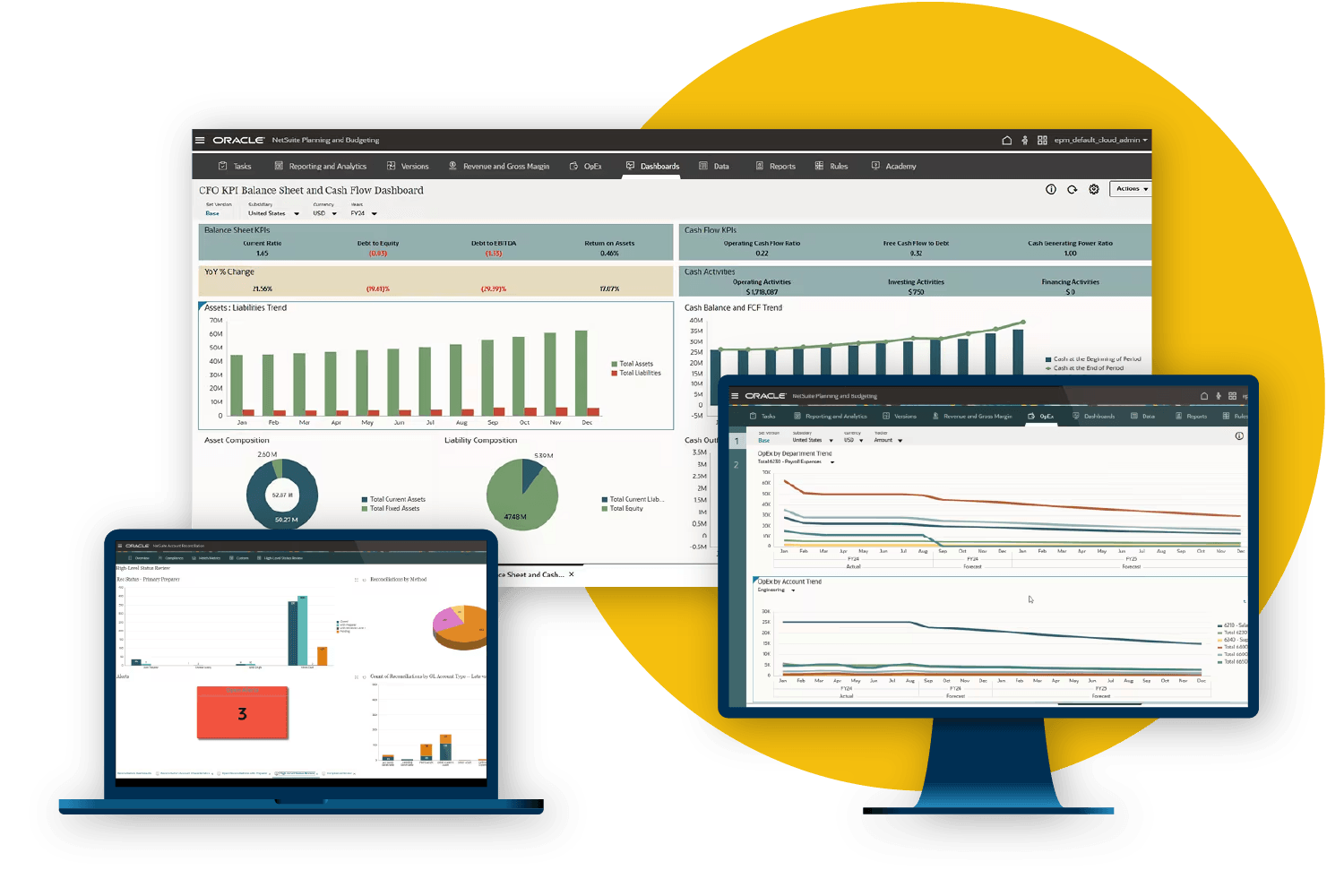
NetSuite Implementation Timeline: 2026 Guide (DACH)
A NetSuite Implementation Timeline runs 8 to 14 weeks for a single-entity company on core financials, 4 to 6 months for a mid-market rollout, and 9 to 18 months for a multi-entity group. Those ranges hold across Germany, Austria and Switzerland, but German projects carry three schedule drivers that international guides omit entirely: GoBD documentation, DATEV and SKR chart-of-accounts mapping, and the E-Rechnung issuing deadline of 1 January 2027.
Cloudmaven, a certified Oracle NetSuite Solution Provider, builds those drivers into the plan before kickoff rather than discovering them during user acceptance testing.
NetSuite Implementation Timeline at a Glance
Duration depends on entity count, data quality, integration volume and decision speed. Headcount predicts almost nothing. A 50-person company with three subsidiaries outruns a 200-person single-entity business on complexity.
Four bands, four different projects
8 to 14 weeks
Single-entity Mittelstand, core financials. Delivered on SuiteSuccess. Adds time: messy master data and undocumented processes.
4 to 6 months
Mid-market, finance plus operations. Standard phased build. Adds time: 3 to 5 integrations, approval controls, audit requirements.
6 to 12 months
Multi-entity DACH group. Custom, wave rollout. Adds time: intercompany consolidation, local tax, multi-currency.
9 to 18 months
Complex international group. Global template plus pilot. Adds time: legacy replacement, multi-language, phased cutovers.
Oracle’s SuiteSuccess methodology compresses standardised deployments to 90 to 120 days. That figure holds only when the business adapts its processes to the template.
The four assumptions holding every range together
Every published number carries silent assumptions. Name them and the estimate becomes defensible:
- Your subject matter experts hold protected calendar time in every phase
- Legacy master data is deduplicated before the first rehearsal load
- Scope is frozen once the solution design document is signed
- No go-live falls inside the Jahresabschluss window or a peak trading season
Break one assumption and the schedule slips by weeks. Break three and the project moves into the next band entirely.
Why two identical projects go live months apart
Module selection sets the floor. Governance sets the ceiling. Two firms buying identical licences land months apart because one answers design questions in 48 hours and the other routes them through four stakeholders. Complexity and decision latency multiply each other.
The Phases: What Actually Happens, Week by Week
A NetSuite implementation splits into eight phases, from mobilisation through hypercare. Each carries a duration, a deliverable, and a definition of done the project sponsor signs before the next phase opens.
Cloudmaven documents this sequence publicly so buyers can compare it against other quotes. You can review how Cloudmaven structures a NetSuite implementation project before signing anything.
Phase 0. Mobilisation
The weeks before the clock officially starts.
Mobilisation grants system access, opens the RAID log, names process owners, and sets the decision model. Most vendors bill this as week one of discovery. It is not. Two weeks lost here delay configuration by two weeks. Nothing recovers them later.
01. Discovery & Requirements
2 to 4 weeks. Stakeholder interviews, gap analysis, process mapping across finance, operations and IT. Rushed discovery causes more failed ERP projects than any technical factor.
02. Solution Design & Sign-off
2 to 6 weeks. The solution design document fixes the chart of accounts, roles, approval hierarchies and reporting outputs. The configure-versus-customise decision lives here.
03. Configuration & Build
3 to 10 weeks. Module setup, saved searches, dashboards, SuiteFlow workflows, and SuiteScript development only where standard functionality genuinely cannot meet a requirement.
04. Data Migration & Integrations
6 to 8 weeks. Runs in parallel with configuration, not after it. This is where legacy data quality gets tested against NetSuite’s referential rules, often for the first time.
05. Testing, UAT & Training
3 to 6 weeks. User acceptance testing validates order-to-cash, procure-to-pay and record-to-report against real transactions, not scripted demos.
06. Cutover & Go-Live
2 to 3 weeks plus the cutover weekend. Final data load, balance validation, legacy lock, go/no-go meeting.
07. Hypercare & Stabilisation
30 to 90 days. Defect triage, integration monitoring under production volume, adoption support. The first live month-end close is the real acceptance test.
The overlap rule
Migration overlaps configuration. Integration testing overlaps UAT. Training overlaps testing. But discovery never overlaps build, and sign-off never overlaps cutover.
Week-by-Week by Company Size
The timeline changes shape, not just length, across company sizes. A single-entity build front-loads configuration. A multi-entity group front-loads design, because the global template decides everything downstream.
Single entity, core financials only
Finance leads. Operations joins only where order-to-cash and procure-to-pay touch the system.
Discovery weeks 1 to 2, design weeks 2 to 3, build weeks 3 to 7, testing weeks 7 to 9, training weeks 9 to 11, go-live week 12.
Mid-market, finance plus operations
Cross-functional coordination adds roughly 8 weeks. Approvals, segregation of duties and audit-ready reporting drive the difference.
Discovery weeks 1 to 4, design weeks 4 to 9, build weeks 8 to 18, migration weeks 10 to 18, UAT weeks 16 to 22, training weeks 20 to 24, go-live weeks 24 to 26.
Multi-entity DACH group: why waves beat big bang
NetSuite OneWorld handles subsidiaries, currencies and intercompany consolidation from one instance. The design effort scales with entity count, not user count.
Groups running a global template pilot it in one subsidiary, stabilise, then roll out in waves. Wave rollouts extend the calendar by 3 to 6 months and cut cutover risk substantially, because each wave inherits fixes from the last.
NetSuite Financial Management anchors every one of these paths. The general ledger, which carries your statutory reporting, must be stable before any operational module goes live.
The Seven Factors That Decide Your Timeline
Score yourself against each of these and your realistic band emerges, without a sales conversation.
01. Entities, currencies and intercompany flows. Each additional entity brings its own tax rules, base currency, chart of accounts, bank connections and local reporting. NetSuite removes the manual consolidation spreadsheet, and adds design and testing weeks in exchange.
02. Process complexity. Conditional approval routing by margin, region or project type multiplies test paths. Firms arriving with digitised invoice approval workflows already mapped shorten design by 1 to 2 weeks.
03. Module scope. Inventory looks simple until locations, bins, serial and lot control, reorder points and landed costs enter the design. Review the NetSuite module portfolio before locking scope, not after.
04. Integration count and type. Each connected system adds design, build, testing and error-handling work. Ownership matters more than code volume.
05. Data quality and history volume. Dirty legacy data doubles migration effort. That is the most consistent pattern across ERP projects, regardless of platform.
06. Customisation depth. A “quick script” touching postings or approvals expands UAT and complicates every future upgrade. Strategic consulting exists to challenge those requests before they reach the backlog.
07. Decision speed. Projects that answer design questions within 48 hours finish inside their published range. Projects that route decisions through committees do not.
Slow decisions cost more weeks than slow developers.
Objection answered directly: adding a partner does not fix a slow internal decision loop. Extra consultants cannot approve your chart of accounts. Naming one empowered decision-maker does more for the schedule than doubling the delivery team.
German & DACH Timeline Drivers Most Guides Ignore
German projects carry regulatory workstreams absent from US and UK guides. GoBD, DATEV, E-Rechnung and works council consultation each consume calendar time, and each has a hard external deadline attached.
E-Rechnung: the deadline that reshapes your kickoff date
Germany’s Wachstumschancengesetz amended §14 UStG and phased mandatory B2B e-invoicing across three dates:
1 Jan 2025
Every German business must be able to receive structured e-invoices.
1 Jan 2027
Businesses with prior-year turnover above €800,000 must issue them.
1 Jan 2028
The issuing obligation covers every business regardless of size.
Compliant formats follow the European standard EN 16931. XRechnung and ZUGFeRD both qualify. A plain PDF does not.
Plan backwards from your applicable date. A group crossing the €800,000 threshold needs its invoicing configuration live and tested before the 2027 window, which places kickoff no later than mid-2026 for a multi-entity build. Cloudmaven scopes invoice approval and e-invoicing readiness inside the implementation rather than as a follow-up project.
GoBD compliance and Verfahrensdokumentation
GoBD governs how digital books and records must be kept: complete, unalterable, traceable, auditable across the retention period. The Verfahrensdokumentation, the written description of how your process and system actually work, must reflect the new NetSuite configuration.
Budget 2 to 3 weeks of documentation effort. Teams that leave it until after go-live rewrite it twice.
Retention rules: archive, don’t migrate
Retention drives your migration scope more than storage cost does. Under §147 AO, as amended by the Viertes Bürokratieentlastungsgesetz effective 1 January 2025:
10 years
Books, records, inventories, opening balance sheets, annual financial statements and the Verfahrensdokumentation.
8 years
Buchungsbelege including incoming and outgoing invoices, reduced from ten under the new law.
6 years
Received and sent commercial correspondence.
Here is the clause that changes migration planning. §147 Abs. 6 AO requires the legacy system to remain available in machine-readable form for 5 years after a system change, after which a machine-readable data carrier suffices.
Your old ERP does not switch off at go-live. Budget its licence and hosting for five more years, and stop migrating a decade of closed transactions you are legally allowed to archive instead.
SKR03, SKR04 and the DATEV handover
German charts of accounts follow SKR03 or SKR04. Mapping either standard into a NetSuite account structure that also serves group reporting is a design decision, not a data task, and it consumes 1 to 2 weeks of the design phase.
Tax filings run through ELSTER, and the USt-Voranmeldung must reconcile to the general ledger from the first period. Cloudmaven maintains a pre-built NetSuite to DATEV integration, which removes the custom build that otherwise adds 3 to 4 weeks to a German project.
Data protection, works council and the German calendar
DSGVO constrains what production data enters a sandbox environment. Personal data in test loads needs pseudonymisation, which adds effort to every rehearsal load.
Betriebsrat consultation applies where the system changes performance monitoring or working procedures. Consultation timelines are negotiated, not fixed. 4 to 8 weeks is realistic for a mid-sized German employer.
Audit season compounds both. Preparing annual financial statements in Germany already consumes your finance team, and the Wirtschaftsprüfer needs the same people you need for UAT.
Switzerland and Austria
Swiss projects add VAT logic, local bank formats and Swiss GAAP FER or HGB-equivalent reporting. NetSuite Swiss Localization covers that layer. Austrian entities follow UGB reporting with their own filing calendar.
Regulation shapes the calendar. Data quality shapes whether you hit it.
Data Migration: Where Most Timelines Break
Data migration ends more implementation commitments than any other workstream. Legacy exports look usable until the first rehearsal load tests them against NetSuite’s required fields and referential rules.
Low complexity, 2 to 3 weeks
Master data plus opening balances. Limited legacy quirks, one rehearsal load.
Medium, 4 to 6 weeks
Master data, opening balances, 3 to 6 months of transactions. Reconciliation volume and inventory dependencies drive effort.
High, 8 to 14 weeks
Multiple years of detail, serial and lot data, bins, BOMs, projects, several source systems. Expect 3 to 4 rehearsal loads.
The migration sequence
Extract from every legacy source in CSV or database format. Map legacy fields to NetSuite fields, where most defects surface first. Transform: deduplicate, standardise, enrich missing required fields. Load through CSV import, the Oracle NetSuite Connector or SuiteScript. Validate: general ledger balances tie, inventory counts agree, aged balances reconcile. Then repeat. Plan 2 to 4 rehearsal loads before the cutover load.
Rehearsal loads are not optional testing. They are the mechanism that finds problems while fixing them is still cheap.
Source system effects
Source system changes the effort materially. SAP Business One and SAP S/4HANA Cloud, Public Edition export cleanly but carry deep custom field structures. Microsoft Dynamics NAV and Microsoft Dynamics 365 Business Central map well on financials and poorly on dimensions. Sage and Lexware exports typically need the heaviest cleansing. DATEV extracts arrive structured but bookkeeping-shaped, needing enrichment before they support operational modules.
The five migration mistakes that add a month
- Cleaning data after go-live instead of before
- Migrating three spellings of the same customer as three records
- Discovering NetSuite required fields your legacy system never captured
- Importing ten years of closed transactions that retention rules let you archive
- Running one rehearsal load and treating it as validation
How Each Integration Extends the Timeline
Every connected system extends the timeline by a predictable amount. Ownership, error handling and reconciliation design consume more calendar time than the code itself.
E-commerce & SuiteCommerce
+2 to 3 weeks. SuiteApp connector.
CRM
+3 to 4 weeks. Middleware or REST API.
Marketplaces
+2 to 3 weeks. Channel manager.
3PL & warehouse (EDI)
+4 to 6 weeks. Middleware or custom API.
Payment gateways & SEPA
+1 to 2 weeks. SuiteApp connector.
Shipping carriers
+1 week. Native SuiteApp.
HR & payroll
+2 to 3 weeks. API integration.
Custom legacy systems
+4 to 8 weeks. Custom SOAP or REST API.
Connector, middleware or custom build
Pre-built connectors such as Celigo and Boomi cost more in licensing and less in development. Custom integrations invert that trade. eUnify, Cloudmaven’s own middleware layer, sits between the two: standard connectors where they exist, custom flows on the same platform where they don’t, which keeps error handling and monitoring in one place.
One platform, one place to look when something fails.
File-based vs API, and the scope drift nobody plans for
File-based transfers stand up in days and create daily operational effort, timing risk and duplicate handling. APIs take longer to build correctly, because retries, idempotency and performance controls all need designing, and they cost less to run.
E-commerce integrations start as “send orders into NetSuite” and grow into inventory availability, customer sync, shipment confirmations, returns and cancellations. Scope that expansion at design time, or absorb it as a delay later.
German payroll, HR and expense
Personio dominates German mid-market HR. The Personio to NetSuite integration moves employee master data and cost centre structures without a custom build. DATEV Lohn handles payroll journals, and SEPA payment files need bank-specific validation before the first payment run. Travel and expense follows the same rule. The NetSuite to Perk integration adds spend management without extending the core go-live, because it connects after financials stabilize.
SuiteSuccess vs a Custom Implementation
The single largest lever on the timeline is the methodology choice. SuiteSuccess delivers speed through pre-configured industry templates. A custom build delivers fit through full design.
SuiteSuccess
90 to 120 days. Limited customisation scope. Pre-built Oracle framework. SuiteApp-based integrations. Best for standardised processes.
Choose it when: your processes match an Oracle industry template, you’ll accept the template’s workflows rather than reshape them, you run one entity with limited integration needs, and time to value outranks process fit.
Custom implementation
4 to 18 months. Extensive customisation. Full phased design. Fully architected integrations. Best for multi-entity, differentiated operations.
Choose it when: you operate multiple entities, currencies or countries; revenue recognition, billing or inventory logic is genuinely differentiated; integration depth drives daily operations; group reporting requires a specific account and segment architecture.
The hybrid path starts from a SuiteSuccess foundation and extends it. Switching templates mid-project restarts the build, so template selection belongs in ERP evaluation, before contracts are signed.
Objection answered directly: SuiteSuccess is not a cheaper version of the same project. It is a different project, one where you adapt to the software. Choosing it to save budget and then requesting template changes produces the worst of both paths.
How Timelines Differ by Industry
Industry shifts the timeline by changing module scope, integration count and data complexity. Two mid-market firms of identical size can sit 8 weeks apart on industry alone.
Software & SaaS
Physical inventory disappears, which shortens configuration. Revenue recognition replaces it. NetSuite for Software Companies covers contract-based recognition, and NetSuite SuiteBilling handles subscription, usage and hybrid billing.
Wholesale & distribution
SKU volume, pricing logic and warehouse processes extend both migration and testing. NetSuite for Wholesale plus Warehouse Management with NetSuite (WMS) typically adds 4 to 6 weeks against a financials-only build.
Professional services
Project accounting, utilisation reporting and time capture drive the design. NetSuite for Service Companies supports project profitability from the same ledger that produces the statutory accounts.
Renewable energy
Asset structures, long project lifecycles and cost tracking across phases extend discovery. NetSuite for Renewable Energy addresses that project-heavy shape.
Agencies
Time tracking, work in progress and client profitability reporting sit at the centre. NetSuite for Advertising and Marketing Agencies covers the retainer and project mix.
What It Costs Across That Timeline
Cost tracks the timeline almost linearly, because implementation fees are consultant weeks. Oracle does not publish list pricing, so every figure below is an industry estimate. Licensing is a recurring subscription covering platform access, user count and modules. Implementation is a one-time services fee. A common market rule of thumb places implementation services at 1 to 2 times first-year licensing.
€25k to €70k
Small, single entity. Core financials, minimal customisation.
€70k to €190k
Mid-market. Inventory, multiple entities, 3 to 5 integrations.
€140k to €450k+
Enterprise. Supply chain, advanced workflows, deep integration.
Hidden costs that also cost you weeks
- Data cleanup: effort scales with legacy record quality, and lands before migration, not after
- Change orders: each mid-project scope change adds 1 to 3 weeks
- Integrations: budgeted individually, never as a bundle
- Post-go-live optimisation: 10 to 15% of implementation cost across the first 90 days
- Sandbox licensing: required for development, testing and every rehearsal load
- Training cycles: recurring, not one-off
Objection answered directly: the lowest quote usually becomes the most expensive project. Underbid scopes recover margin through change orders, and every change order buys weeks off your calendar. Compare quotes on scope depth and phase gates, not on headline price.
Your Team’s Time, Phase by Phase
Internal capacity determines whether the timeline holds. A partner configures the system. Your team supplies decisions, validation and adoption, and no consultant substitutes for that.
Discovery, 15 to 20 hrs/week
CFO or Controller, Operations lead, IT lead.
Design, 10 to 15 hrs/week
Department heads across the affected functions.
Configuration, 8 to 12 hrs/week
Department leads validating build against design.
Data migration, 10 to 15 hrs/week
Data owners, Finance, IT, reconciling every rehearsal load.
UAT, 20 to 30 hrs/week
Department leads and end users. This is where availability breaks projects.
Cutover, 40+ hrs
The core project team for the cutover weekend.
Who must be irreplaceable
Three roles carry no substitute: the finance owner of the chart of accounts, the operations owner of the fulfilment process, and the executive sponsor who unblocks decisions. Everyone else can hold a named deputy.
UAT is where availability breaks projects. Finance teams already run month-end close, and stacking user acceptance testing on top of close week guarantees slippage. Audit season is worse: a finance team supporting a Wirtschaftsprüfer cannot validate opening balances at the same time, which is why go-live dates cluster outside audit windows in German projects.
Shorten the Timeline Before Kickoff
Preparation compresses the timeline more reliably than any delivery technique. Work completed before contract signature costs nothing in consultant hours and removes weeks from discovery and migration.
The pre-kickoff checklist
- Deduplicate master data. Merge customer, vendor and item duplicates in the legacy system. Export a clean list and count the records.
- Document current processes. Map order-to-cash, procure-to-pay and record-to-report as they actually run, including the spreadsheet workarounds. A structured understanding of how ERP systems work makes those workshops faster.
- Name your decision-makers. One owner per process area, one executive sponsor, one escalation path.
- Set a decision SLA. 48 hours for design questions, written into the project charter.
- Decide your history scope. Apply the §147 AO retention rules and archive rather than migrate whatever the law permits.
- Protect calendars. Block UAT and cutover weeks now, before other projects claim them.
- Run an ERP evaluation. A structured ERP evaluation fixes scope before a partner starts billing discovery hours.
Parallel workstreams, early data ownership and thin-slice demos all compress the schedule without cost. Cutting UAT, skipping rehearsal loads or shortening training does not compress anything. It moves the same work into hypercare, where it costs more and damages adoption.
Why Implementations Run Late
Late projects fail for familiar reasons. Timelines slip because of governance far more often than because of technology, and the governance signals appear weeks before the date moves.
People & governance
- Subject matter experts double-booked against business as usual
- Decisions spread across too many stakeholders with no single owner
- Weak executive sponsorship, so escalations stall
- Design by committee, producing requirements nobody owns
- Shortened UAT to protect a date that then slips anyway
Technical & scope
- Dirty legacy data discovered during rehearsal, not before
- Integrations scoped without naming the system of record
- Over-customisation that expands testing and complicates upgrades
- Scope creep after configuration begins, when users first see the system
Red flags by phase
Discovery: decisions undocumented, owners unassigned, sponsors skipping steering meetings.
Build and migration: changes without formal approval, migration errors repeating across rounds.
UAT: incomplete test scripts, unavailable key users, defects accepted without fixes.
Cutover: go/no-go skipped, cutover plan untested, hypercare staffing undecided.
Intervention beats recovery every time.
Three weeks behind is recoverable. Re-baseline the plan, freeze scope formally, escalate the two decisions blocking configuration, and move the go-live to the next clean window rather than compressing UAT. Management consulting support at that point costs less than a failed cutover.
Go-Live: Choosing the Date and the Approach
Go-live approach and date shape the final weeks of the timeline. Three deployment models exist, and German fiscal timing narrows the viable calendar considerably.
Big bang
Everything switches on one date. Simpler to manage, higher risk, standard for mid-market projects with a planned cutover weekend.
Phased
Modules or entities go live sequentially. Lower risk, longer duration, more complex data management during transition.
Parallel
Legacy and NetSuite run simultaneously. Safest and most expensive, since your team performs every task twice.
Best and worst go-live dates on a German calendar
Early in a new month, early in a new quarter, outside audit season. That is the window.
Avoid December and January entirely, because year-end close and the Jahresabschluss timetable consume the same finance team you need. Avoid August, when German holiday coverage thins out project teams and vendor support alike. Avoid the fortnight before any USt-Voranmeldung filing deadline.
Go / no-go criteria
- UAT scripts passed and signed off
- Final migration reconciled, general ledger opening balances tied to legacy
- All integrations tested in production, both directions
- Roles, permissions and saved searches validated
- Training complete by role, cutover plan rehearsed
- Rollback plan defined, hypercare staffing confirmed
- Legacy system retained in read-only access, satisfying the §147 Abs. 6 AO five-year requirement
The first month-end close in NetSuite is the real acceptance test. Teams that rehearse close during UAT complete their first live close on schedule.
After Go-Live: Hypercare and Phase Two
Hypercare extends the timeline by 30 to 90 days beyond go-live. Real transaction volume surfaces gaps that no test environment reproduces, and the first live close exposes every remaining reporting defect.
Days 1 to 30
Daily standups, defect triage, permission fixes, integration monitoring under production volume.
Days 31 to 60
First month-end close with hands-on support, report refinement, workflow adjustment.
Days 61 to 90
Second close, adoption reinforcement, transition into managed services.
Underfunded hypercare produces workarounds that become permanent.
Adding modules after go-live
Phase-two additions run 4 to 12 weeks each, depending on scope. Additional NetSuite modules drop onto a stable foundation faster than they would have inside the original build, which is exactly why sequencing them second often shortens total elapsed time.
Adoption decides the return. Role-based training after the consultants leave keeps new hires and process changes from eroding the configuration. Measurable return appears in cycle times first: days to close, invoice approval turnaround, order-to-cash duration. Enterprise Performance Management layers planning, budgeting, forecasting and consolidation on top once those operational metrics stabilise.
Holding a Partner Accountable to the Timeline
Contract structure protects the timeline better than any project management method. A credible partner commits to phase gates in writing, not to a single go-live date in a proposal.
What a credible commitment looks like
- Named phase gates with entry and exit criteria, not just milestone dates
- Duration ranges per phase, with the assumptions that produce them stated openly
- A named delivery team that stays from discovery through go-live
- A defined change-order process with stated timeline impact per change
- Hypercare scope and duration written into the statement of work
Fixed price vs time & materials
Fixed price delivers cost certainty and creates friction at every scope boundary, which slows change-order approval. Time and materials delivers flexibility and requires trust plus tight governance. Neither is safer by default. The deciding factor is how well discovery defined the scope.
Six questions to ask before signing
- Who does discovery, and do those people stay through go-live?
- How many DACH implementations has this team delivered, and can we call two references?
- How is DATEV, SKR mapping and E-Rechnung handled, and is it in scope?
- What are the exit criteria for each phase gate?
- What happens to the timeline if we miss a decision deadline?
- What does hypercare include, and for how long?
Ask question three first. The answer separates partners who work in the German market from partners who work near it.
How Cloudmaven Delivers NetSuite in Germany and DACH
Cloudmaven manages the full timeline as a certified Oracle NetSuite Solution Provider, covering licensing and delivery under one accountable contract. The company operates from Olten, Switzerland across 16+ locations and 30+ countries, with 120+ ERP and EPM specialists.
400+
Projects delivered
350+
Customers across DACH and beyond
120+
ERP and EPM specialists
Certified partner and CFO advisor
Cloudmaven positions itself as a CFO advisor rather than a software reseller. The focus sits on the financial architecture as a whole: planning, consolidation, real-time reporting and compliance. NetSuite anchors that architecture for most DACH clients.
Solution Provider status matters for the schedule. Licensing and implementation run through one party, which removes the handover gap where dates usually slip.
Integrations, middleware and the wider stack
Integrations and Middleware sit at the centre of the delivery model. Pre-built connectors cover NetSuite to DATEV, NetSuite to Personio and NetSuite to Perk, and eUnify carries custom flows on the same platform.
Beyond the ERP layer, AI Process Automation removes manual steps in finance operations, and Financial Consolidation and Close shortens group reporting cycles. Cloudmaven also delivers Microsoft Dynamics 365, iplicit and Everest, which means the ERP recommendation follows the requirement rather than a single product line.
Support and proof
The Customer Success Team and IT Support function takes over after hypercare, so the transition from project to operations has a named owner rather than a gap.
Results appear in the published Success Stories. Qualifyze moved revenue recognition from five working days of manual effort to full automation in NetSuite. Clients include Breitling, Stadler, Bitpanda, Austrian Airlines, AEG Power Solutions and Bühler.
Bring your entity count, module scope and target date
Contact Cloudmaven for a scoped timeline built against your actual requirements.
Frequently Asked Questions
Common questions cluster around duration, phases, cost and German compliance. Short answers follow.
How long does a NetSuite implementation take?
Most mid-market implementations take 4 to 6 months. Single-entity financial rollouts complete in 8 to 14 weeks. Multi-entity or heavily customised projects run 9 to 18 months.
What are the phases of a NetSuite implementation?
Mobilisation, discovery, solution design, configuration, data migration and integration build, testing and UAT, cutover and go-live, then hypercare.
How long does NetSuite data migration take?
Between 2 and 14 weeks depending on complexity tier, with 2 to 4 rehearsal loads before the cutover load.
What is NetSuite SuiteSuccess and how fast is it?
SuiteSuccess is Oracle’s pre-configured deployment methodology using industry templates. It targets 90 to 120 days for businesses that adopt standard workflows.
How much does a NetSuite implementation cost?
Industry estimates run from €25,000 for small single-entity projects to €450,000 and above for enterprise deployments. Oracle does not publish list pricing.
What is the biggest cause of NetSuite implementation delays?
Decision latency. Slow sign-off on design questions creates rework that no additional consultant capacity recovers.
How long should hypercare last after go-live?
30 to 90 days, covering at least two month-end closes.
Can a NetSuite implementation be completed before the German e-invoicing deadline?
Yes, with realistic sequencing. Companies above €800,000 turnover face the issuing obligation from 1 January 2027, which means starting a multi-entity build no later than mid-2026.
Does GoBD compliance extend a NetSuite implementation timeline?
Yes, by roughly 2 to 3 weeks for Verfahrensdokumentation and audit-trail validation.
When is the best time of year to go live with NetSuite in Germany?
Early in a month or quarter, outside December, January, August and audit season.
How long does migrating from DATEV or SAP to NetSuite take?
DATEV extracts arrive structured and need enrichment. SAP exports are clean but carry custom field depth. Both typically add 1 to 3 weeks over a simple financials migration.
Does the works council need to be involved, and how long does that take?
Betriebsrat consultation applies where the system changes working procedures or performance monitoring. Plan 4 to 8 weeks.
How long does it take to add a NetSuite module after go-live?
4 to 12 weeks per module on a stable foundation.
What can we do before kickoff to shorten the timeline?
Deduplicate master data, document current processes, name decision-makers, set a 48-hour decision SLA, and decide history scope against retention rules.
Building a Timeline You Can Defend
A realistic NetSuite Implementation Timeline comes from your entity count, data quality, integration scope, regulatory obligations and decision speed. Published averages describe other companies. Your schedule comes from scoping yours.
German projects carry an extra layer. GoBD, §147 AO retention, SKR mapping, DATEV handover, E-Rechnung deadlines and Betriebsrat consultation each consume calendar time, and none of them appear in international implementation guides.
Cloudmaven scopes those obligations into the plan from discovery, delivers as a certified Oracle NetSuite Solution Provider across Germany, Austria and Switzerland, and stays through hypercare into managed support. Talk to the team about your target date and entity structure.

Let our experts advise you without obligation